Collected expertise on specific topics

BAT Wastewater Directive Industry
The so-called “BAT Wastewater Directive for Industry” is not a separate directive, but refers to the application of Best Available Techniques (BAT) to industrial wastewater treatment.
It is based on the European Industrial Emissions Directive (IED) – Directive 2010/75/EU – and is specified in more detail in sector-specific BAT reference documents (BREFs) and BAT conclusions. These documents contain binding emission ranges and serve as the basis for national limit values. Affected industries such as metal processing, chemicals, automotive, and food production must adapt their wastewater treatment to this state of the art in order to meet legal requirements and environmental targets. We offer industry-specific solutions for this purpose, e.g., evaporators, ultrafiltration, and foreign oil separators to reduce emission values and recycle water in the production process.
It is based on the European Industrial Emissions Directive (IED) – Directive 2010/75/EU – and is specified in more detail in sector-specific BAT reference documents (BREFs) and BAT conclusions. These documents contain binding emission ranges and serve as the basis for national limit values. Affected industries such as metal processing, chemicals, automotive, and food production must adapt their wastewater treatment to this state of the art in order to meet legal requirements and environmental targets. We offer industry-specific solutions for this purpose, e.g., evaporators, ultrafiltration, and foreign oil separators to reduce emission values and recycle water in the production process.

Zero Liquid Discharge ZLD
Zero Liquid Discharge (ZLD) describes a treatment concept in which liquid residual streams are reduced to the greatest extent that is technically and economically feasible. The goal is to maximize water recovery and recycling.
Up to 95% water recovery possible
Significant reduction in disposal costs
Compliance with strict environmental regulations
Sustainable solution for industrial processes
ZLD systems are often based on modern evaporator technology
Industrial Wastewater Treatment
Technologies, Applications and Process Solutions
A Technical Guide
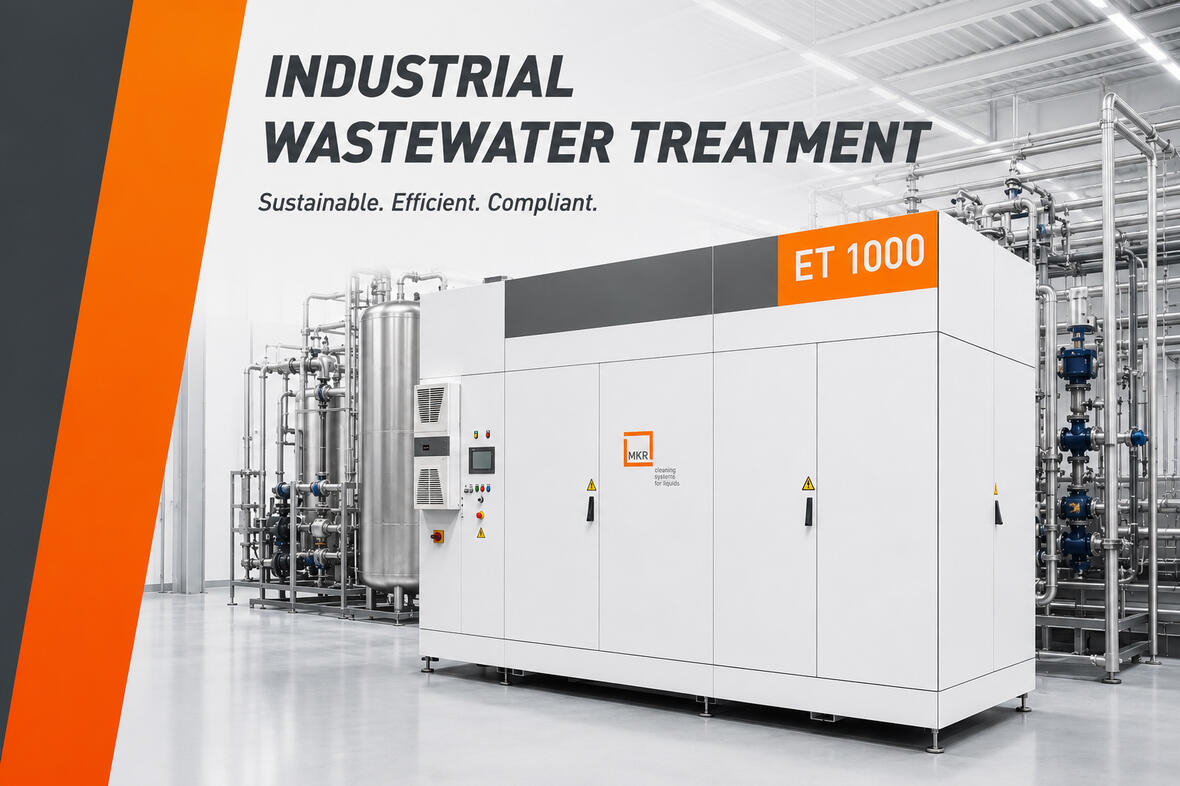
From wash bath care to Zero Liquid Discharge - MKR develops modular solutions for the treatment of industrial process media and wastewater.
Industrial wastewater treatment includes technologies for treating, separating, concentrating or recovering contaminated liquids from production processes. The goal is to reduce wastewater volumes, recover process water and keep industrial liquids in efficient circulation.
Mechanical Vapor Recompression
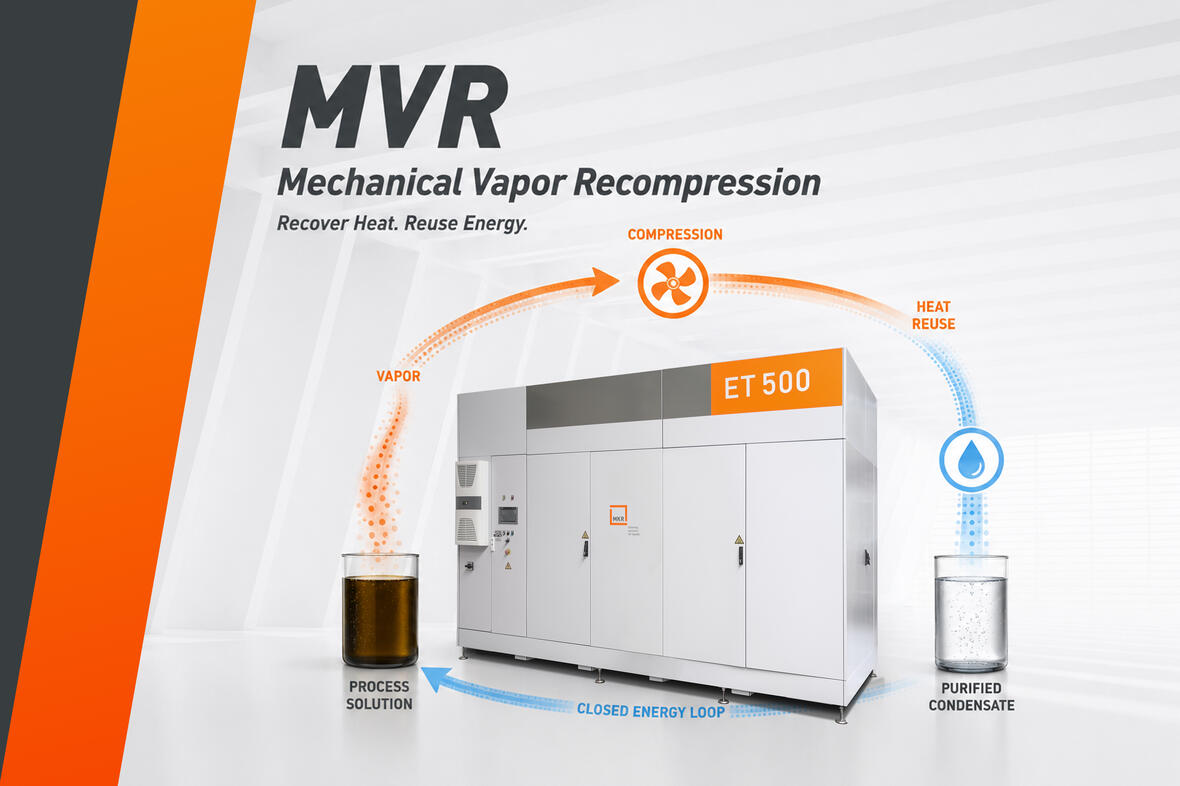
Mechanical Vapor Recompression, or MVR, is a key technology for energy-efficient evaporation in industrial wastewater treatment. In MVR evaporation, the water vapor generated during the evaporation process is not discharged as unused waste heat. Instead, it is mechanically compressed and reused as thermal energy within the process.
In industrial wastewater treatment, MVR can help reduce wastewater volumes, recover process water and improve the energy efficiency of evaporator systems. Especially for continuously generated process wastewater, Mechanical Vapor Recompression is an important technology for economical and resource-efficient treatment concepts.
MKR uses MVR in the atmospheric evaporators of the ET series. This creates an efficient energy loop within the system and reliably separates industrial wastewater into distillate and concentrate.
MVR makes evaporation not only technically possible, but also energetically efficient.